
New Delhi: In a significant shift toward performance-linked climate accountability, the Zero Prize was announced as India’s first national results-based environmental award that directly links financial rewards to independently verified reductions in air, water, and land pollution.
The Zero Prize aims to align environmental funding with measurable, science-backed outcomes rather than projected impact.
Convened by the School of Policy and Governance (SPG), the Zero Prize is supported through philanthropic contributions, corporate CSR partnerships, and institutional stakeholders.
The initiative seeks to create a credible results-driven framework for environmental performance.
With a total corpus of ₹5 crore, the Zero Prize will award ₹1 crore each across three categories – Air, Water, and Land – to solutions that demonstrate scientifically validated pollution reduction within defined geographies.
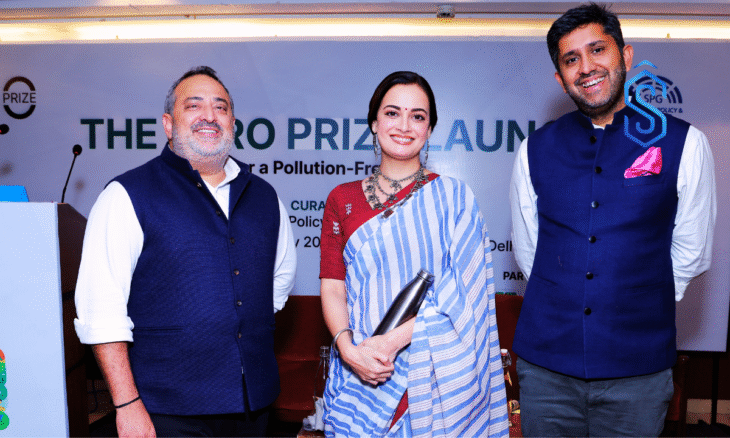
The announcement event was held at India Habitat Centre in the presence of award-winning actor and environmental advocate Dia Mirza as Chief Guest, alongside policymakers, sustainability leaders, and industry stakeholders.
Also Read: Cities of Care Conference Highlights Research-to-Policy Pathways for Climate-Resilient Indian Cities
Zero Prize Open to Startups, NGOs, Corporates and Innovators
The Zero Prize is open to startups, NGOs, corporates, municipal bodies, research institutions, and individual innovators across India.
Eligible applicants must implement a real-world pilot within defined urban or peri-urban contexts and undergo independent third-party monitoring and validation.
Early-stage concepts without measurable on-ground execution will not qualify under the Zero Prize framework.
While climate commitments and sustainability capital continue to expand, organisers of the Zero Prize observed that much of the ecosystem still rewards announcements, pilot-stage activity, or projected outcomes rather than independently verified environmental performance.
The Zero Prize seeks to bridge this gap by recognising only measurable, attributable pollution reduction achieved within defined physical boundaries.
Leadership Backing for Zero Prize
“For 140 years, my family has built a legacy on the power of nature through Ayurveda. But today, that very nature is under threat. ,” said Saket Burman, Co-Founder of Zero Prize and Vice Chairman, Dabur India Ltd..
“I am proud to support the Zero Prize, a ₹5 Crore national challenge that encourages Indian entrepreneurship and Jugaad to come up with high impact scalable solutions.
We are looking for the proven innovations that will make India’s air, water, and land measurably cleaner for the next generation. It’s time to move beyond the boardrooms and into the field. No promises.Only results.”
Ruchir Punjabi, Chair, School of Policy and Governance, added, “Innovation is often messy, but in the fight against pollution, it needs to be abundant. The Zero Prize is a bridge. By offering India’s first results-based incentive, we are mobilizing the country’s brightest problem-solvers from tech startups to civic researchers to tackle our environmental crisis with the same urgency as a unicorn exit.
We are looking for the disruptors who can leverage the economic opportunity of making India more livable. If you have a solution that is science-verified and ready to scale, the stage is yours. Let’s build an ecosystem where the most impactful solutions don’t just survive, they win.”
Also Read: Namma Bengaluru Challenge 2026 Awards ₹25 Lakh Each to Five Climate-Tech Startups
Scientific Validation and Independent Monitoring Framework
Each shortlisted solution under the Zero Prize will establish a documented baseline and demonstrate quantifiable reduction over a 12-month challenge period.
Air: Reduction in particulate exposure within defined zones will be assessed through fixed-location monitoring systems adjusted for meteorological variation.
Water: Pollutant load reduction – including parameters such as BOD, COD, TSS, and nutrients – will be measured at defined discharge points using CPCB-aligned protocols.
Land: Reduction in waste leakage or improper disposal will be assessed through traceable weight-based audits and documented verification.
All claims under the Zero Prize will undergo independent third-party validation, with awards granted only after verified baseline-to-post-intervention environmental improvement. Key findings will be made publicly accessible.
Application Timeline and Evaluation Process
Applications for the Zero Prize open in March 2026 and close in August 2026. Winners will be announced in February 2027 following technical evaluation, pilot implementation, and independent validation.
The Prize follows a milestone-based disbursement structure aligned with successful pilot execution and verification.
Structured as an annual national initiative focused on results-based environmental recognition and performance-linked funding, the Zero Prize aligns with national missions including the National Clean Air Programme, the National Mission for Clean Ganga, and the Swachh Bharat Mission 2.0 by accelerating verifiable, on-ground environmental outcomes.